



Fossil skull of wolf lizard beast
The wolf lizard (genus name: Inostrancevia), also known as the Inostrancevia, is a genus of theropod animals in the order Theropoda. It is a quadrupedal animal with four limbs standing upright below its body. The skull is 45 centimeters long and approximately 1 to 4.3 meters in length, with strong muscle attachments on the bones. Compared to other more primitive theropod animals such as the Bamo crocodile, the wolf lizard has smaller eye sockets and larger temporal fenestrae. Fossils were discovered in Sokolki, North Dvina River basin, Arkhangelsk Oblast, Russia. Wolf lizards lived in the Late Permian period 251 million years ago. South Africa has also discovered wolf lizards, which have been named African wolf lizards.
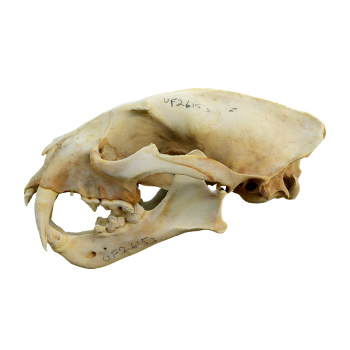
Cloud leopard skull
Neofelisnebu is a carnivorous mammal belonging to the feline family Neofelisnebu. There are unique cloud like flower spots on the back and sides of the body; The primary color of the fur is uniform light blue to gray, with large cloud like patches on the sides of the body; Two intermittent black stripes extend from the spine to the base of the tail; There are 6 longitudinal lines on the neck, starting behind the ears; There are large black oval plaques on the limbs and ventral side; There are plaques on the crown of the head, white on the nose and snout, and dark stripes extending from the eyes and corners of the mouth to the side of the head. It inhabits primitive evergreen tropical rainforests, but is also found in secondary forests and logging forests. Prey small mammals and birds, and attack chicken coops. Night walking, living alone.

Double crowned Cormorant Skull
The double crowned cormorant (Phalaclocoraxauritus) is a bird species in the family Scomorantidae of the order Characiformes. Its beak is strong and long, with grooves on both sides of the upper beak and a hook at the tip, making it suitable for pecking at fish; There is a laryngeal sac at the base of the lower mouth; Small nostrils, completely concealed in adult birds; Expose your eyes first; Slender neck; Two wings of moderate length, lacking a fifth secondary feather; The tail is round and hard straight, with 12-14 tail feathers; The feet are located at the back of the body; Short tarsus without feathers; Flat toes, long hind toes, connected by webbing. After diving, the feathers are soaked and need to spread their wings to dry in the sun before they can fly. Residing on islands, coastlines, and swampy areas. They mainly eat fish and crustaceans.

Barracuda skull
The barracuda is a fish species belonging to the family Scorpaenidae in the order Perciformes, suborder Scombroidei. Also known as Barracuda or Sparrow Brocade, it is a species of ray finned fish in the family of Barracuda, belonging to the genus Gobiidae. The body is elongated, with a pointed front end and a slightly flattened rear end. Belonging to a global fish species, it is distributed in various sea areas around the world. So far, 20 species of barracuda have been discovered, and barracuda in different seas have completely different behavior patterns. However, their "solitary" behavior is a common feature, and adult barracuda have almost no natural enemies. Juvenile fish feed on planktonic animals, while adult fish feed on diatoms and small organisms. Usually inhabits the sea

Fossil skull of canine toothed beast
Cynodont, the ancestor of mammals. More like mammals than reptiles. Some live in pairs in caves. Ancient creatures, only two large canine molars have been found in the petrified forest of Arizona. Most canines are carnivorous animals, with very few exceeding 90 centimeters in length. They have many similarities with mammals. Both canines and mammals can breathe while chewing food. They all have several different types of teeth. Like mammals, canines have whiskers and perhaps body hair. Dogtooth beasts have their limbs located beneath their bodies and can run quickly.

Black footed Albatross Skull
Phoebastrianigrills is a large seabird belonging to the family Albatrosidae in the order Siluriformes. It is a monotypic species with no subspecies differentiation. The body length is 79-83 centimeters. The mouth is black, the base of the mouth and the area under the eyes are gray white, and the rest of the body is black brown. Some individuals have white tail feathers and black feet, which can distinguish them from short tailed albatrosses. Breeding in groups, enjoying following boats to forage, often inhabiting the sea. Distributed in the North Pacific. China is commonly found in the Taiwan Strait, and in the South China Sea during spring and winter, with very few populations. Mainly foraging for marine invertebrates and fish such as cephalopods and mollusks.

Mink skull
Neovisonvison is a mammalian species belonging to the genus Neovisonvison in the family Italidae, order Carnivora. The tail is less than half the length of the head, and the ears are short and round. The body is slender and the limbs are short. The head is narrow and elongated, with a sensitive sense of smell and hearing. Residing in areas near freshwater. The lifestyle is semi aquatic. Carnivorous, mainly feeding on rodents, bird eggs and chicks, fish, insects, and plant fruits. Distributed in the United States and Canada. Usually active at night, occasionally appearing during the day. He is a great swimmer who can dive to a depth of 5 to 6 meters and won't chase prey for long distances in open waters. Still a skilled tree climber.

Fossil skull of saber toothed tiger
Thylacosmilus is an extinct marsupial mammal that lived in prehistoric South America. It was a large terrestrial carnivore that once lived and competed with the saber toothed tiger. But the saber toothed tiger is actually a marsupial mammal, not belonging to the feline family, and even not to the carnivorous order. It only resembles the saber toothed tiger in appearance due to convergent evolution. Living in the Quaternary period of the Tertiary period. The body size is not very large, the largest of which is equivalent to the size of a jaguar and four times that of a pack wolf. He was one of the larger meat beasts in the southern cuisine at that time, with developed sword teeth and a strong body.

Grey whale skull
The gray whale (scientific name: Eschrichtiusrobustus) belongs to the family of gray whales in the suborder of baleen whales of the order Artiodactyla. It has a larger body circumference than species in the family of baleen whales, but smaller than the humpback whale; Its adult length is 10 to 15 meters (female whales are slightly larger than male whales), and its maximum weight exceeds 35 tons. The body is spindle shaped, with a thick and chubby trunk, thickest near the fins, and gradually narrows towards the tail. Without dorsal fins, there are 8-15 low peaks along the posterior one-third of the spine, with the first peak being the largest and decreasing towards the tail. Mainly feeds on planktonic small crustaceans, herring eggs, and other group fish. But they do not feed during their southward migration.

Cheetah skull
The cheetah is a carnivorous mammal of the feline family, also known as the Indian leopard. Deep chest cavity, narrow waist. The rough short hair is light yellow with black round spots; The abdomen is white without spots, but the tail has markings, with a total of four to six black rings at the end. Males are larger than females. To live in Africa and West Asia. The residential areas in Namibia are diverse, including grasslands, savannas, dense vegetation areas, and mountainous regions. They feed on small and medium-sized ungulates such as antelopes and small horned horses. Living alone or gathering in groups with small families. He is the fastest hunter in Africa. Not only does it represent rebirth and lifelong protection, but it also symbolizes the power hidden in the darkness.

Tiger skull
Tigers belong to the feline carnivore family and hunt a variety of animals for food. They are usually accustomed to hunting from dawn to sunset and mainly feed on large mammals. It can hunt prey larger than its own size, and a tiger weighing 250 kilograms can hunt an Indian bison weighing 900 kilograms. Tigers in the wild can eat up to 40 kilograms of meat at a time. Without disturbance, they usually return to the hunting site within three to six days after catching prey to enjoy the remaining food until there is little left. The difference between tigers and other cats is that they are good at swimming.

Chihuahua skull
Chihuahua is a carnivorous mammal in the family Canidae, also known as a teacup dog, Chihuahua dog, etc. Petite in size, with an apple shaped head, large and thin ears, and two ears standing upright. Widely distributed around the world. Intelligent, lively, clingy, vigilant in action, with a tenacious will, very brave, and even possessing certain hunting abilities. I enjoy the heat, love sunbathing, and dislike the cold. It is the smallest ornamental dog breed in the world and one of the oldest breeds in the world. As early as the era of the Inca Empire, it was the inviolable dog of the Holy Spirit in people's minds at that time. In 1923, the Chihuahua Dog Club was established in Mexico; Britain was also established in 1949.

Warehouse owl skull
The barn owl is a bird species belonging to the family Scophthalonidae in the order Scombriformes. Its head is large and round, with a white, sometimes brownish face, brown eyes, and light brown around the eyes; There is a brown or orange yellow collar ring around the face, with light brown yellow spots on the neck and shoulders, and slight black brown and white spots; The rest of the upper body is light gray, with brownish yellow feather edges. Each feather is covered with light brown insect spots, and there are white spots with black edges near the end; Tail feathers are white; The leg feathers are light brown and reddish brown, with sparse gray black spots. Residing in the dark areas of residential buildings, mountain caves, tree holes, or hidden places with dense leaves, sleeping during the day and active foraging at night, catching mice and large insects.

Red sea turtle skull
Caretta is a marine animal belonging to the order Turtles and family Turtles. The body length is 100-200 centimeters and the weight is about 100 kilograms. The head is relatively large, about 15 centimeters wide; Both the upper and lower jaws have extremely strong hooked beaks. One more claw than a green sea turtle, suitable for swimming. The tail is relatively short. I enjoy foraging in coral reefs, continental shelves, or shallow waters covered in brown algae. Mainly preys on benthic or floating crustaceans, mollusks, cephalopods, jellyfish, and other invertebrates. Distributed in warm waters of the Atlantic, Pacific, and Indian Oceans, as well as in the South China Sea and East China Sea.

Catfish jaw
Catfish is a species of bony fish in the family Siluridae of the order Siluriformes, also known as pond lice or catfish. Its body is flattened on the side, its abdomen is flat and soft, it can expand or contract, its body height is greater than its head height, and the external contour of the whole body is chiseled. Living in a reservoir with abundant water, grass, and muddy bottom layer. During the day, it often hides in deep water and is active in foraging at night or dawn. After autumn, they live in deep water or mud to overwinter, and their feeding intensity decreases. When feeding, do not gather in groups and hide in the crevices of the underwater rocks to observe. Carnivorous, feeding on small benthic fish as well as small nearshore fish. Catfish have strong adaptability and fast growth, and have been listed as one of the three major freshwater fish species in natural water bodies in China.

Green tree python skull
The green tree python is a chordate animal belonging to the family Anaconda in the order Perciformes. Green tree python, with a robust body and distinct head and neck; The scales on the head are small and granular, and the heat sensitive sockets are mainly located in front of the scales on the snout, upper lip, and lower lip; The body color changes significantly, with juveniles appearing yellow and orange red; The back and sides of the adult body are bright green, while the ventral surface is mainly yellow; The juvenile has white spots with black ring patterns on the edges of its body, and fine lines passing through the eye sockets. The habitat range of the green tree python ranges from vast plains to high mountains at an altitude of 2000 meters, so it can withstand temperatures below 10 degrees Celsius. It is a beautiful ornamental snake. Has a petite physique and a vibrant appearance.

Wolverine skull
Wolves are mammals of the family Wolveridae in the order Mustelales. More than 1 meter in length; Shoulder height is about 60 centimeters; Wide mouth fissure with canine teeth; The parenting bag opens backwards; Tail length, gradually becoming thinner, straight without bending; The whole body is covered with short hair, dense and thick. The most important difference from wolves is that they belong to the marsupial group, where females have a very shallow, backward opening pouch on their abdomen with two pairs of nipples inside. Due to its tiger like markings, it is also known as the Tasmanian tiger. It was once widely distributed on the Australian continent, inhabiting open forests, grasslands, and gravel. They mostly live in gravel during the day and go out to hunt at night, often hunting alone or as a family.

Sea Lion Skull
Sea lions are a collective term for carnivorous mammals in the sea lion family; There are a total of 5 genera and 14 species. Round head, fin shaped limbs as flexible as wings, and hind limbs that can turn backwards. Most sea lions have thick short fur on their bodies, with a thin layer of fluff underneath. However, the fur color of various sea lions is not consistent, mainly yellow brown and brown. Has a distinct tail, but is relatively short. Some species have long hair on their necks, similar to the mane of a lion, hence the name sea lion. He is known as the 'Lion King of the Sea'. Can dive to a depth of over 300 meters. At the same time, sea lions are also very intelligent sea beasts.

Polar bear skull
The polar bear is a species of bear in the family Ursidae, and is the world's largest terrestrial carnivore, also known as the white bear. The body is large and robust, with a shoulder height of up to 1.6 meters. Adult males weigh between 300-800 kilograms and can grow up to 2.5 meters in length. Females are relatively small, weighing 150-300 kilograms and measuring 1.8-2 meters in length. Similar to brown bears, but without shoulder humps. Living in waters covered by ice in the Arctic Circle. The depth of winter caves can reach the permafrost layer. The preferred habitat is the floating ice in the Arctic Ocean. The fractured and refrozen ice edges and pressure ridges provide the best hunting grounds. Usually acting alone.

Lynx skull
Lynx is a carnivorous mammal belonging to the feline family and the lynx genus. Weighing 18-32 kilograms, with a body length of 90-130 centimeters and a tail length of only 11-24 centimeters. The limbs are long and agile, the ear base is wide, the tips of the ears have black raised clusters of hair, the tail is short and blunt, and the cheeks have long and drooping sideburns. Cold loving animals, with extremely diverse habitats, live in forest and shrub areas, and are more common in dense forests and mountain rocks. Likes to live alone, skilled in climbing and swimming, strong hunger tolerance, can lie down in one place for a few days, not afraid of severe cold, feeds on rodents, wild rabbits, and also preys on small wild boars and deer. Widely distributed in Europe and northern Asia. It is the national beast of Romania.

Seal skull
Seals are a collective term for the family of seals in the order Cypriniformes. The body is obese and round, with a spindle shaped body and limbs that have become fin shaped; Head nearly circular; Big and round eyes; No external ear canal; Kiss short and wide; The upper lip tendrils are long, thick, and hard, resembling beads. Female seals can live up to 30 years, while male seals have a lifespan of less than 20 years. Almost all over the world, mainly distributed in the Arctic Ocean, Atlantic Ocean, and Pacific Ocean. Distributed in coastal areas of China. Has a habit of living in groups and will lie on rocks or beaches by the sea to rest. The food range is very wide, including various fish and crustaceans, as well as penguins.

Vulture skull
Vulture is a large raptor belonging to the family Aquilidae in the order Aquiformes. The head and neck of adult birds are partially exposed, with brown down feathers from the forehead to the occipital region; There are sparse black hair like down feathers around the head, eyes, and ears, and exposed eyebrows and neck; Blue gray skin with needle like clusters of feathers at the base of the neck; The body feathers are dark brown, and the flying feathers are black brown; Iris dark brown, beak strong; The young bird resembles an adult but has a darker body color and a more exposed head. Because its head is covered in feathers and there is a partially bare bald area behind its neck, it is called a vulture. In Xizang, China, there is a kind of funeral called "celestial burial", which means that human bodies are placed in the wild and eaten by vultures, which is closely related to the local culture.

Skull of Nanluji dolphin
The Nanluji dolphin is the only dolphin in the southern hemisphere without a dorsal fin. Distributed around Antarctica. Mainly found in temperate waters, with most records occurring in the northern part of the Antarctic Circle. Often following the Humboldt cold ocean currents to subtropical latitudes, possibly as far as the northern coast of Chile at 19 degrees south latitude. Prey various fish and squid, especially lanternfish, which is the most common. Enjoy group tours, with hundreds or even thousands of people forming groups. Southern ridge dolphins may be mistaken for penguins when they are far away from the sea or traveling rapidly; And when it slowly marches, it will be mistaken for a sea dog or sea lion. The southern humpback dolphin is named after the larger, wingless southern right whale.

Wolf skull
Wolves are carnivorous animals in the family Canidae. There are a total of 11 subspecies. Medium and symmetrical body shape, slender limbs, toe mobility, conducive to fast running. The head and palate are pointed, the face is long, the nose protrudes, the ears are pointed and upright, the sense of smell is sensitive, and the hearing is developed. Canine teeth and split teeth are well-developed. The fur is thick and long. The forefoot has 4-5 toes, while the hind foot usually has 4 toes; Claws are thick and dull, unable to stretch or slightly able to stretch. Hairy tail, more developed. It is a nocturnal animal that is good at running quickly and over long distances. It prefers to live in groups and often curls up alone or in pairs in caves during the day. However, it also comes out for activities during the day in sparsely populated areas. Come out at night to search for food.

Popular Models


Honey Badger (3D animated model)
192 View

Guinea fowl (3D animated model)
163 View

Wild Goose (3D animated model)
185 View

Red Fox (3D animated model)
153 View
Random Model


British Railways Class 9 1 EMU
729 View

British Cornish Pies
653 View


Blue Jay (with 3D animated model)
909 View


Christmas Gingerbread Man Cookies
822 View

White Music Tape
707 View

wooden frame glass display cabinet
1159 View